Long-term trends v. the 24-hour news cycle
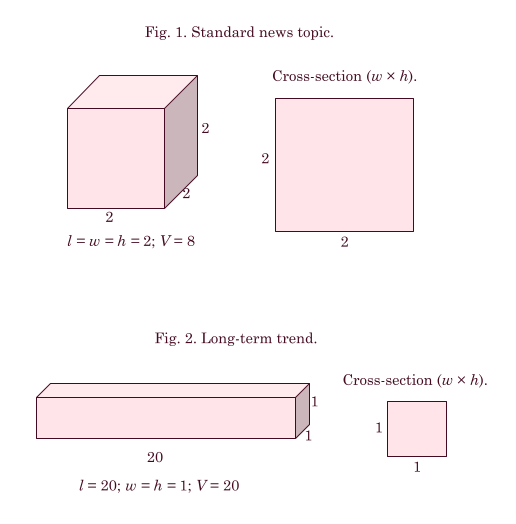
Standard news can be said to cover several (but not all) dimensions. In this example it is reduced to two—width and height.
Fig. 1 shows a standard news topic (an extreme weather event—hurricane, wildfire, &c; a single mass shooting). Evaluated w × h (the two dimensions the 24-hour news cycle considers) equals four.
Fig. 2 shows a long-term trend topic (climate change, the gun violence trend). Evaluated w × h equals 1.
Based on an analysis of relative w × h (the cross-section the news cycle uses), the topic shown in Fig. 1 would seem to be far more newsworthy than that of Fig. 2: 4 > 1 (assuming for the purpose of this proof that larger numbers merit more coverage).
However, adding l, the third dimension which the typical merit analysis elides, gives Fig. 1 a value of 8 and Fig. 2 a value of 20. By this analysis 20 > 8, and thus Fig. 2 is very much more newsworthy.
In the real world, of course, the third dimension l is not length but time, sustained existence. Climate change (for instance) as a long-term trend spans a larger time of relevance, but the current criteria for newsworthiness, measuring only w and h, rank more ephemeral events as more newsworthy.
(Note: Since I wrote this up (in 2019 at the latest), I think the news has improved in its coverage of long-term trends. For instance, many news outlets used various acute events, like wildfires, as jumping-off points to talk about climate change. However, many long-term trends, such as Third World poverty, public health, and malaria, don't really get covered at all. To some extent, this is okay, because the news is supposed to tell us about current events. But there should be some publications that discuss issues in proportion to their size (e.g., in terms of the amount of suffering caused (although this is obviously not perfect because dedicating 30% of every issue to the same problem would be unhelpful unless 30% of advances in science and thinking are related to such issue)).